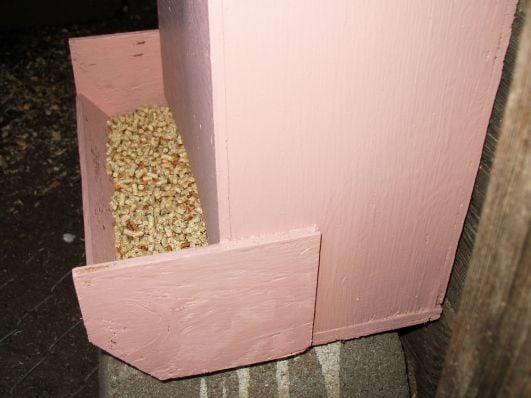
When my wife and I were thinking about getting chickens one of our concerns was how difficult it would be to care for them. I’ve got friends who completely “baby” their chickens (e.g. chicken diapers, baths, cleaning their watering dishes daily with bleach, etc.). I’ve also got friends who barely even deal with their chickens other than to make sure they’ve got some food and some water (no matter how dirty). I wanted to find a good balance between these two extremes, between fanatical and neglect.
One of the big “chicken care” questions was regarding food and water. I wanted to automate this process as much as possible.
WATER:
I looked into quite a few different solutions for getting water for my girls. One of those was to setup a nipple watering system. The pro’s of this system were:
1) They wasted less water.
2) They took up less floor space.
3) They didn’t fill up with dirt, feathers, leaves, shavings, etc.
The biggest cons of this system were going to be setting it up and training my girls how to use it. After buying a few of these nipples and testing them I decided I’d try something else.
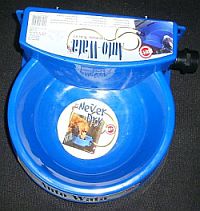
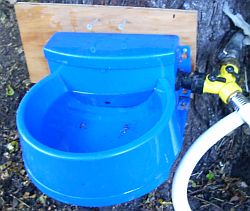
I saw some automatic poultry watering systems at the feed store but they were pretty expensive. I found something at Wal-Mart that works just as well and have been VERY happy with it. It is a “Never Dry Auto-Wata” system for dogs. It was only $12.78.
 FOOD:
FOOD:
NOTE: This feeder (dubbed Frankenfeeder) is the perfect example of function over form. It worked great in all of it’s hideous glory! Below is an update with the new homemade chicken feeder I’m currently using (a bit better looking, more functional, larger capacity).
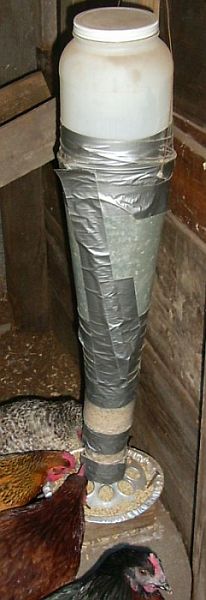
I saw a lot of different feeding systems and couldn’t decide what to do. I had a few extra mason jar feeders and thought I’d attempt a modification to one of them. If it didn’t work then I’d go out and buy something.
I took the mason jar feeding attachment and a small plastic peanut butter jar that was the same size as a mason jar. I cut the bottom off of the jar and attached a bigger peanut butter jar to the smaller one. I cut out the bottom of that one and took a long piece of A/C conduit and funneled the end a little to fit into the larger peanut butter jar. I then cut out the bottom of a big plastic container and attached it to the top of the conduit. Finally I cut some holes into the conduit and plastic container and threaded through some wire. This wire would support the majority of the weight of the feeder and take pressure off of the jars. I really like this feeder because it was cheap, takes up very little floor space, is easy to refill, holds a lot of feed, and oh yeah… it was cheap! I haven’t kept excellent track, but it seems that I only need to refill this feeder about 1-2 times a month. To the right is the finished product. It isn’t pretty, but is works GREAT!!!
Another idea I had was to add a tin pie plate nailed to a piece of wood that would catch the food as it is “billed out” by the girls. This keeps a substantial amount of food off the ground and from being wasted. The wood and the nails also help keep the feeder in place and from falling off of the cement block it is resting on. Below is a closer look
Additional Notes:
- My chickens spend most of their day free ranging in a large section of the back yard.
- The automated water system is outside of the coop / run.
-
I’ve got the feeder in the chicken run with a gallon waterer. I need to refill this waterer about every two weeks.
-
I feed my chickens old wheat from food storage and day old bread I get for free from the local supermarket. I also give them piles of worms and bugs from my compost bin. I haven’t noticed any decrease in egg size, frequency, or quality, but I have noticed a HUGE drop in the amount of feed I have to supply. This is wonderful since chicken feed in the city is about $14 for a 50 lb. bag.
-
I decided to do a test and didn’t give my girls any bread, wheat, worms and they weren’t let out of the run as much. They went through the whole feeder full of layer pellets in about a week!
UPDATE 9/15/07
I finally upgraded my “temporary” feeder so something a lot bigger and hopefully a bit nicer looking. You can read all the details here: HomeMade Chicken Feeder
UPDATE 12/2/09
My system has been working great for years. There were only two problems I’ve had:
- Waterer: The white supply hose going to the auto chicken waterer split open and gave our yard a good soak. I’m not sure if it was a weak spot because of a kink or if maybe a thirsty rat wanted a drink. A $2.75 hose mender and 10 minutes later everything was fine.
- Feeder: During a really bad storm some sideways rain got into my wood feeder… what a mess! I took the whole thing apart, scrubbed it out with bleach, let it dry really well and painted it all over an put it back together. Of course I also made sure that there would be no way water could get at the feeder again!
Please visit my site http://www.backyardchickens.com/ for a ton of great info on raising chickens.
Also, register with our 5,000 member community of chicken addicts: www.backyardchickens.com/forum/
wow, i absolutely love the waterer idea. I have a “regular” old chicken waterer, made of galvanized steel. it is starting to wear out (leak) and i have been seeking a super solution. This may just be the ticket. I live where it freezes (alot) in michigan, so i’ll need to address that issue for sure. This will be the 1st winter for the birds.
excitedVulcan, thanks for the comment. A few notes:
1) The chickens sometimes jump up on the waterer and the plastic started to break where the top screws hold it to the wood. I ended up putting a block under the waterer to support it.
2) I’ve seen some people use a small 40 watt light bulb in a tin can underneath their waterers to provide just enough heat to keep the water from freezing.
I picked up a six foot section of 12″ square (in cross section) ductwork from a salvaged heating system. I intend to use this as the vertical portion of the feeder, using this concept. Feed will go in from the attic loft (with a cover to keep out mice and a hardware cloth screen to prevent accidental feed back loss down the chute). How does the feed get to the loft you may ask? I used an old garage door opener and a pulley from a neighbor’s tractor (both free) to winch it up to the loft door. Total cost for lift: cable and hardware ~ $15. Ductwork: free
j hodge4ns, that sounds fantastic! I’d love to see pictures!
I’ve since upgraded my feeder to something a bit nicer / bigger. See it here:
http://www.backyardchickens.com/forum/viewtopic.php?id=16717
Any ideas on how to keep the water from freezing? I don’t have electric in the coop.
In addition to bringing out fresh water daily during the winter, you can also put a container of snow in the coop for the chickens. That way they can get a good deep drink every day, plus nibble at snow (which they love) between times when they’re a little thirsty.
When you say you feed your chickens old wheat from food storage…what does that mean?
Ann, I’ve never had a problem with freezing water, but some people on the chicken forum ( http://www.backyardchickens.com/forum ) have put 40 watt bulbs under a tin can that sits under the waterer and is just enough heat to keep things from freezing.
Elvi: by “old wheat from food storage” I’m referring to the wheat our family has kept in case of emergencies. We like to store a few months of emergency supplies “just in case” something really terrible happens. It is a good idea to rotate through these supplies after a bunch of years, and since we’re not up for eating a few month’s of wheat it goes to the birds… literally! 🙂
your are cheep!!!!!!!!!!!!!!!!!!!!!!!!!!!!!!!!!!!!
I’m nearing completion of my coop right now, I’m just getting ready to insulate and sheetrock. After seeing your feeder, I’ve been pondering building something similar “into” my coop. My plan is to use the gaps between the studs (2×4’s 16″ on center) as the chute. This way I’d only have to build a trough at the bottom and a door for refilling at the top. I could put the refill door inside or out, or maybe even both. and it will take up less floor space in my coop. Thanks for sharing your great idea.
I’m amazed at how dirty my 4 chicks get their water container everyday (by pooping in it or kicking up shavings). The water ‘inside’ the container is still fresh, but the part they drink from ends up filthy so I end up having to dump out the good water to clean the bowl. I was just wondering if you have to clean the ‘auto wata’ bowl everyday for the same reason? I ask cause I like the idea of a automatic waterer, and was trying to decide between the Little Giant (with small hanging bowl) or one like yours.. thanks!
Wow what a kindred soul you have. Duct tape and 16 penny nails! You make this old carpenter cry.
I have watched my chickens take a drink, turn 180 degrees and then poop right into the water. After observing this a few times I elevate the rim of the waterer to the height of their back. They have to strech a bit but the water stays a lot cleaner. It seems to help keep out the litter as well. A better idea I went with is to put a hardware cloth floor about 2 feet above the litter and suspend the waterer from the ceiling adjusting the height as needed.
I use a metal container instead of plastic because I need to keep the water from freezing. (Non heated coop) A 40 watt bulb directly in contact with the metal works in all but the coldest weather then I go with a 75 watt. The shade on the drop light keeps it away from the roost which is above. When I mix little chicks with the adults I put a small watterer outside the fence of the run where hens cannot knock it over. I also elevate it with bricks/blocks.
Rett, that is a very interesting idea to use the stud cavity. I’d suggest you fill another one with oyster shell while you’re at it!
Alalele, keeping the waterer a little higher than their backs really helped keep the water clean. I actually put it even a little higher so they have to stretch a little to get at it, but the water was very clean. I say “was” because now that I’ve added a duck all hopes of a clean water bowl are gone!
estpr13, sounds like you’ve got a great setup! I’m really glad I don’t have to deal with freezing water containers, but I’ve seen the light bulb trick and it doesn’t take much to keep the water from freezing in most climates.
Hello
Any idea where i can get 1/2 dozen nipple pecker i am in the process of making a water supply for the wifes 8 rescued battery hens they have come on leaps and bounds in about 4 weeks they are producing about 5….6 eggs a day but we get one soft shell nearly every day why? the diy is after my own heart ps we have just had a R A F Fly past chucks did bat a eye lid (LOL)
Excellent ideas, here. My coop is about 1/3 done and I really like your ideas for building the feeder hopper. Thanks!
read your ideas plus other peoples going over to allotment later to build a new feeder and lift water container to shoulder hieght the chickens not mine
thanks for the ideas george
That is a great idea about the pet watering system.
I am getting me one for sure.
Thank you for some great ideas.
I built a rig similar to this with out the bulb. I used a cattle tank float instead because a water hose hooks right up to it. I like this over bowl designs because it doesn’t get dirty. My chickens like to dance in the water of a bowl design.
http://www.backyardchickens.com/web/viewblog.php?id=4655-Auto_Waterer
Will adult hens drink out of a typical “chick waterer” with the holes and mason jar system? I have one pet hen and it seems silly to keep a huge waterer in the coop that she never empties before it gets dirty.
Sure, she’ll drink out of it, but if you raise your large waterer off the floor a little, it should stay pretty clean, especially with just one hen, and you won’t have to refill it every day. Raise your waterer 6-8 inches off the floor and see if that doesn’t help keep the dirt and other grime out of it. I just sit mine on top of a couple cinder blocks and it stays relatively clean until it needs to be refilled (about 2 weeks with 9 chickens)
Chickens swallow using gravity and don’t have a valve between their beaks and their crops so recently eaten food can spill out while they are drinking. The best solution to the dirty water problem is to elevate the waterer above the level of their crops!
(and of course their bums!) tee hee
Thanks for the tips. With winter coming in Minnesota, water hygiene is definitely something that I don’t want to worry about too often. 🙂 I’ll try the raised waterer- I always got the impression that chickens had to “bow” down to get a drink.
I have guinea fowl for the first time and was concerned about water freezing during winter. I have put out a heated bucket of the kind used by dogs, and so far haven’t seen them use it. I was interested in the idea of the light bulb, so may resort to that method. Really good tips.
I made a much more simpler water dish that stays pretty clean. I used a regular dog feeder from Walmart (the kind you fill with food in a tower like concept and it trickles into a bowl which is attached. Its $14. Then I ran 1/4″ tubing you use for drip sytems thru a hole I cut in the lid , into the reservoir. I set a regular water timer for gardens to go off for 1 minute, two times a day. I turned the faucer all the way up so there is a really strong stream coming into the feeder. It cleans it out quite good. Place the whole feeder on gravel and sprinkle some kind of cover crop seeds into the cracks in the gravel. In the summer you will have a ever renewing source of clean water and greens.
Great idea Davilyn! Your timing is also perfect as I just (literally 2 mins ago) came in from washing out the waterer. What I usually do is just manually spray a bunch of water in the bowl and reservoir to flush everything out. A more manual process than what you described, but seems to do the trick.
You can buy a heater to sit under your waterer, they are sold in all farm and ranch stores, and they are not too expensive. Also we are in Wyoming where it freezes in the winter, we have heat lamps when it gets really cold. Putting a light in your chicken house in the winter will keep the hens laying.
We have around 80 chickens
I live in BC, Canada and it is under -20C right now. I have just set up a water system for the wild birds I feed using a second hand food warming tray I picked up at a thrift shop for under $5. This one has a thermostat control so I can set it on low. High would draw 100 watts but so far the low setting is enough to keep a cake pan with water and a few rocks in it from freezing. I used to use something like this for my chickens. Also, a car battery warmer is a blanket type of device that could be wrapped around a water jug or a heating pad might also work. I put duct tape on the edges of the metal pan and covered the cord connections to protect from moisture and short circuiting the whole thing. You can get shrink wrap type protectors from some auto or electrical supply places. (also handy wherever you need to use extension cords outdoors) Currently waiting for our city council in Kamloops to approve a pilot project for urban hens. I miss having chickens. Fingers crossed.
i am really impressed with the design of the feeder you have which is painted yellow
We use vinyl rain gutter for feed and for water troughs, works great. Lots a room for a pretty good sized flock of thirty. And so cheap, about six dollars for ten feet.
I like your automatic waterer idea, but we developed one that I think is better. It took weeks of trial and error, but we came up with one that not only automatically dispenses the water, it keeps the water pristine (which makes my hens very happy.) It’s basically like a big guinea pig water bottle, but with a special nipple that chickens can drink out of. You can see it on our website at http://www.waldeneffect.org.
I love that I went looking for info on a Canon i860 and wound up on a glorious chicken site. I had eleven girls until two years ago. I retired the chicken yard because it got flooded and I didn’t have the resources to fix the water problem. I plan to re-introduce chickens this year and am so happy to find this friendly site. I love the feeder ideas. What I’m looking for is a mechanism I can put on a timer that will open and close my little chicken door. If I go a way for a few days I either have to have a chicken sitter or risk loosing birds to the varments. (Racoons and Possums). Any suggestions?
Oops! As Emily LaTella of SNL would say… “Never mind”. I just caught the Auto Coop door articles. Tally Ho.
I Have a 4gallon alum. waterer and have a big problem with the inside getting slimy very quickly. I wash it out with soapy water and rinse it well and still it gets really slimy, any Ideas???
Our chickens were in an enclosure in our barn until last month when a tornado blew it away:( They had a dirt floor which worked fine. Now we have them in a wooden building that used to be a playhouse. It is about 6′ x 8′. It has a wooden floor. We have about 12 birds in it.
Now we have to figure out how to deal with feed and water and manure on the wooden floor.
In the barn we suspended the waterer from a chain which kept it clean (except they somtimes roosted on the pole above it), but they tilted and swung it so that some water leaked on the ground. So, I agree with what the posters above say about raising it up to keep it clean, but then how to prevent spillage?
Hi i live in central california and dont know much about chickens. My fiance came home awhile back with the only survivor,a badly injured white chicken that had fallen off one of the “Foster Farms” trucks aparently on its way to meet its DOOMI never in a million years figured this bird was going to live due to the extent of its injuries and the terrible gurggling in its chest, so i just did my best to make it comfortable using a heat light,cooking him pinto beans and hard boiled eggs and fresh fruit. Didnt know what else to do but make it comfortable. The gurrgling was terrible and for sure i figured he was going to die WEll GUESS WHAT “CHICKEN” as i named it is very alive very VERY big and has just learned how to COCKA_DOODLE DO and has a big red spike thing on his head and long neck hanging chicken lips under his chin!!! Anyway “Chicken” is not a chicken but a rooster AND hes our pet. We love him . what we dont know is how to properly care for him. I need advice about the dirty water bowl CONSTANTLY!! We made him a big coop and got him a girlfriend. Her name is “BERT” cuz thats how she talks she goes BEERRRRR-BER-BER-BER-BER BER . Hence the name. But “BERT” wont lay any eggs and we got her from a guy who says she was of laying age. Please help me with all this cuz we want to keep them and really want to do the best for them we can. I actually raise Mini Dacshounds and well there is a differance any help would be appreciated from the water bowl issue ,the eggs not being layed , the proper diet anythingh is great. Also i was told that its hard to keep a chicken with pneumonia alive(which i assume is what he had cuz of his gurrgling. Oh one more thing my sister inlaw says “GREAT now we are officially “White Trash” cuz weve got 2 chickens” i say shes a bit@#!!!
Thank You
Randi in california
oh chicken is been with us at least 2months now also one more question He has a very dirty area way deep into the feathers surrounding his DERRIER for lack of a better term. i mean a black area it is on top half where his tail feathers would meet the skin. No odor but im not running behind him “SNIFFING” his booty feathers. Also he hasnt gotten his spikes in will they come in and will he poke us with em? He doesnt try to get us at all.
I am not an anmial specialist, but I think they are all chickens, then some are roosters, some are hens, and some are capons–like deer, bucks, and does.
Please feed your chickens and roosters chicken scratch and hen ration purchased from a local farm and ranch store. They also need clean water daily and you can also purchase a waterer and automatic feeder from the same place usually. You also need to take the dirty part that is on your rooster off either with a paper towel if dryed or soak his butt in warm water so this comes off. This is usually caused from improper food, too rich, etc. They do like greens, lettuce romaine, anykind of veg’s dry alpha, cracked corn, but if you feed hen ration, or scratch you can treat them with the green veg’s not as a main diet. If you raise chickens they also need room to roam, so if you put them outside, remember, dogs, cats, coons, possums, raccoons also like chickens, so you have to make a coop, with all sides, top and bottom covered so nothing will fly in or dig under. You use chicken wire, and they also need a place out of the elements, so they need an enclosed little room.
We have over 100 chickens and 6 roosters. I sell eggs to the local people as our chickens are all feed with no antibotics….natural food only. You can also tell your sister, not all people that raise chickens are white trash, we are farmers and we also have geese, ducks, goats and sheep. Tell her if it wasn’t for us ‘white trash’ farmers she wouldn’t have any food!
Getting back to your rooster, beings it came from the foster farms it could be a capon, but it sounds like he acts just like most roosters. Glad you saved him,and since you did he will probably never get mean, my roosters are not mean, it is usually banties and fighting ones that get mean. I have never had a mean rooster
Thank you for your info. Id like to ley you know we have a rather large & completely enclosed 10x15ft PEN. we have made an henhouse (I think its not made right) and we have also put a overhang over part so they have that extra shaded area because our temps out here reach well into the high 90s and 100s we also feed them scratch from our local feed store but knew nothing bout the hen ration. Is this something the rooster will eat as well. Also how is he a capon whats the detrmining factores. We are sitting here trying t figure out just how the heck do we wash his butt with soap and water? Let me try to explain in greater detail the area thats black. if you were rub him down his back like you do a dog starting from its neck to where the dogs tail starts Ive used my keyboard to try to draw the area im speaking about with my x key marking the area_______x/”’ .Its only on top but when your able to get a good look into his feathers wow is it black like hes gotten into black tar oil. And as far as my sister inlaw well you know what they say “A fox smells its own hole!!!!” anyway thanks again for the time and infor u provided and the hardwork it takes to reise these very interesting and misunderstood creatures we call chickens!!!! one more little thing id like to know is it possible to construct a harness of sorts to take them on a walk like can they be leashed to walk em safely? also ooops forgot to ask can we reaise chicks with this pair.?
randi in cali
The black tar area is probably dryed blood from his fall off the truck, I would not worry about it. Do not give chickens a bath, this includes roosters, the only thing they need is a mite powder to keep any lice away. This you can also get at the farm store or go on line to mcmurrayhatchery.com . You should also get some oyster shell for the hens, they need this to produce strong shells on their eggs. This rooster is probably not a capon and it is very hard to tell if it is as you would have to remove the feathers to see where they made the incision, he is probably a broiler and he will get very large, so make sure the hens you get are a large breed also. Like white leghorns,White Rocks, or Black Stars, or one of the other large ones. Yes you can raise chicks, it is best you have a couple(2-4) hens to one rooster.Otherwise he will wear just one hen out.
My chicken that I have on the porch just follows me around, of course we do not live in town. The other hens picked on her so I just moved her to the porch and she stays there with the stray cat someone dropped off during the night and she roams free all day, comes in the porch at night. So also lays her egg in the chair almost everyday. Most chickens do not lay everyday, they lay 6 out of 7 days. I have heard of chickens that lay everyday, but I have never checked my ones in the hen house, just this Rhode Island Red that I have on the porch. They make a harness for parrots, but I guess you could make one for a chcken. Maybe a small/medium dog harness could be made to work, but remember they have small heads and large breasts.
Glad they have protection from the sun as they do not like real hot weather. You also need straw for the nest boxes, you can use the plastic milk carriers for nest boxes, or build your own, also chickens like to roost on something high at night, (2-3 feet off the ground) so put in a rod or something they can jump/fly up on, make sure it is not too small in size as they have large feet 2-3″ diameter is probably good. They probably sell raising chickens books at McMurray’s Hatchery,would be a good buy.
I really enjoy my chickens, geese, ducks and etc.
Judi in Wyoming
Also the rooster will eat the hen ration. Remember you don’t need a rooster for the hen to lay eggs, but you need a rooster to make the eggs fertile. Judi in WYO
Remember your ‘weiner dog’ is a killer of many things and chickens fit into his program. We also have the ‘weiner dogs’ Hunter is our 4th ‘weiner’ and he likes to chase ducks, chickens, kill birds (if he can) and has tryed to chase the geese but the geese chase him and it is pretty funny when ‘he’ gets chased.
Judi in WYO
First on behalf of myself and “Chicken” and “Bert” Id like to thank those of you who have taken the time to give me such wonderful and informative advice on caring for these guys. I never thougfht of chickens as anything but ,well you know to eat. But thety really are cool animals and i just love ours dearly. I realize that reaisingf ANY anumal is a job aqnd it will last FOR THE REST OF THAT ANIMALS LIFE so i am greatful for those that took the time to answer me so that i may provide a healthy and safE Aand nurturing enviroment for my newest family members. Id like to assure you that we have a harmonious family here where all our animals get along well and the doxies could absolutely casre less about the chickens. However they are safely behind the walls of their fully enclosed chicken area. that weve done our best to make sure nothing leaves and nothing enters.!!! One more rather stupid question ok So is that story bout that headless chicken named mike really true, i mean did that chicken REALLY lose its head only to be found the following day in a corner with its own head tucked under its wing still alive.? I just cant stand to think its true it makes me so sad for that bird i just have the most horribly saddening images when i think aboiut it. Please tell me its just a fake story…………pleeze
Everyone take care and if ever the need for any canine help i can help. Id like to include an important finding that has been rewcently discoverd by the animal center for poison control .they have learned that Grapes and raisins are toxic to our canines. They report that they havent determined the exact substance in the raisins ir grapes (raisins being more toxic due to their concentration i cup of 6 cups of grapes is equal to 1 cup raisins. The symptoms mim ic those of poisoning by rat poison and with many of our vets unaware of this new finding they often mis diagnose the illness. Thias is a deadly forem mof poisoning with the final end of our beloved canins is total renal failure. If not treated IMMEDIATLY and AGRESSIVELY your canine will die a horribly painful and heartwrenching death. So please pass this on to anyone that isnty aware. It will save a life. I live in the raisin capital of the worlkd and believe it or not most people here are still uneduacated even my own beloved bobble head loe was inflickted with this illness but because of the agressive treatment and longterm aftercaRE HE IS STILL WITH US HERE TODAY!!!!
Listen to Judi. She knows. Most everything I was going to say she has already said. We have had chickens for 4 years and are still learning.
She is also very kind because many of your experiences are of someone who would have only thought of a chicken as a pet or like a dog. If one of our chickens becomes high maintenance, we are thinking about the next time we could get around to making it dinner.
Don’t do the harness thing until you have had it longer. Your pen is plenty big enough for two birds–even large ones. You could have 10 in there–not saying you should. Birds can be hard to catch, but if you want to take one out and are nervous about catching it, do it when it is just about to get dark. When it is dark, they are very easy to handle. Also, as she said, it is easy to make them trust you to follow you around and pick them up.
That reminds me. I hope you have a roost for the birds. It is very easy to make. Anything to simulate a tree branch. They don’t like to sleep on the ground.
I recommend you get a book I would tell you ours, but I don’t know the rules on this site about recommending books. Also there is another forum that has lots of chicken information, but again, I don’t know the rules about posting other sites.
I don’t know the story about Mike the headless chicken, but can tell you that once the head is off, the chicken will be dead in a few minutes.
Dogs can be trained to leave the chickens alone.
How tall is your fence? Chickens can fly.
If you want eggs, the chickens need so many hours of light per day.
Listen to Judi on roosters. You don’t need one unless you are hatching eggs. That is fun, but also dificult.
PS: Dogs don’t need people food or dog food. They need wolf food. A wolf would not eat a raisin or a grape, but would eat other stuff that we never feed them–like a whole rabbit. We don’t want to feed them whole rabbits or mice so we (Western People) try to simulate wolf food and call it dog food. That statement needs to be mitigated by breed types. The more bred a dog has been (from the wolf) the more sensitive the dog’s digestive system is.
Good ol’ “Headless Mike” do some Google / Youtube searches and you’ll see some great stuff about him. I think he lived for a few years with most of his head / brain chopped off.
As for another forum: Since I own http://www.BackYardChickens.com I strongly suggest everyone that has chickens visit that site and also join our community of over 30,000 members! 🙂
Hi All,
Some really great ideas here. I use a 2 gallon paint bucket in the winter with a heat tape wraped around it. Works quit well. No pooping in it. Only clean and refill once a week.
Summertime I use an automatic waterer attached to a 5 gal. bucket. Just turn the hose on once in a while to refill the bucket. It actually gets dirtier than the 2 gal bucket does.
DId make a hanging bird feeder some years ago that holds a 50lb sack of feed. Incorperated it into the chicken coop. Made out of 1x12x20, with hinged roof to fill. 2 large eye bolts on the sides towards the top to hang with #9 wire.
Love all the automatic door closes and openers too. Especially the paint stick one. Simple and easy.
My girls won’t even come out in the snow. I have to sweep it off the ramp and the part of their yard that isn’t covered.
Thank You All for your ideas, comments, sharing, and time.
Barb
I’m just getting the “chicken fever”. Can anyone please answer these questions –
With the deep litter method, can you use straw or does it have to be wood shavings? If you have an area with a cement pad, can you put the coop there and use the DLM (straw) and not harm the hens? Do you cover your coop and run with something in the winter to avoid getting your litter wet so it doesn’t stink?
To Jerri;
We use straw on our chicken house floor. Also you need a place where the chickens can go in at night to roost enclosed for that they need a roost, and yes you need a cover or roof on your coop. Depending on where you live, chickens need 8-10 hours of light all year round in order to keep laying. Read the above notes from Rural near Dallas and mine, we have over 100 chickens . If you have anyother questions please ask, we will be glad to help,
Judi in Torrington, Wyoming
Hi guys and girls,
I use mulch in the coop. The kind you get from tree trimmers. Keeps dried out and has been down for some time.
Also if you use kittly litter under the roost…things smell much better. And it dries up the poo. Some one suggested putting a sheet of plastic under the roost first. Then just pull out the whole mess and start over. Works and smell great. At least for 10 chickens and a Roo.
This summer I sprinkle a bit of powered lime everywhere like the old timers used in the outhouses. TSC had it 7.99.
To Mo Hillbilly
You must remember chickens eat and scratch things on the ground, people use pesticides on their grass, fertilizers, and weed killers, These items are toxic to chickens if eaten. Also the perfumed kitty litter is also toxic if eaten. Lime if highly deadly so becareful what you put under your roosts. Chickens do not do well with modern pesticides and etc. Keep them healthy go natural. The grass is a good idea if you know what has or has not been put on it.
Judi in Wyoming
Again I say, please listen to Judi.
I have to add expound on my agreement. Our chickens are free to come an go outside. The chicken hole was cut just large enough for them. Sometimes I wish it were larger. NOTE: their outside area is fenced against predators, otherwise we would have to close the door each night. That means there is not much to clean up inside.
Outside they eat the grass that grows, but we try to put grass clippings in there. They are our clippings and we don’t use any of that junk. The fact that we are eating the meat and eggs should be sufficient, but I am amazed at people who put toxic pesticides and herbicides on their vegetable gardens–Amazing.
I disagree with a lot of what environmentalists say, but one thing I agree with is that we must stop poisoning our food, water, and air. There are natural alternatives. If you are tempted to poison, write back and I will give you a natural solution.
Thank You Judi and Dallas. I didn’t realize lime was poisionous. We used it for pickles when canning.
The kitty litter can’t be reached by the chickens though. But as you have pointed out it is going to be put in the ground somewhere.
Dallas if you have a home remedy that is not poisionous I would surley like to use it. Any and all your remedies would be welcome. Thank You.
Am glad I put the ideas out here so they could be corrected and made better. I did and do not intend to poison or be mean to them and/or our enviroment.
Thank You Both,
Barbara
ps: I catch alot of flies with a can of sardines in maybe 4 plastic water bottles or such filled half full with water. One little 1/4 inch hole in the lid of the bottle. And the proverable fly strip of course.
Please do not get me wrong, I am NO tree hugger, but I do love animals and believe we should eat eggs that are natural, we also do not feed medicated food. I believe that the animals deserve the same treatment as we do when it comes to food and water.
Hope you have as much fun with your chickens as we do.
Judi in Wyoming
Mo. Hillbilly,
You asked for a home remedy, but what are you wanting to solve?
All,
By the way, speaking of kitty litter, we are experimenting with cracked corn. Cats seem to like it, and there are much less questions as to where to put it. We don’t need clay anywhere on our property, and no worries with the corn having anything added to it as it was intended as livestock feed.
In Reply to Dallas,
RuralnearDallas Says:
March 18th, 2009 at 3:15 am
Our chickens were in an enclosure in our barn until last month when a tornado blew it away:( They had a dirt floor which worked fine. Now we have them in a wooden building that used to be a playhouse. It is about 6′ x 8′. It has a wooden floor. We have about 12 birds in it.
Dallas, you should put your waterer on a longer chain and get rid of the pole, or raise the pole higher so the chickens cannot fly up to it. It really sounds a bit crowded in a 6×8 playhouse for 12 chickens with feed and water in there.
Also Dallas I am continuing to use kitty litter unscented) under my roosts. Clay is really not a bad thing. With the wire grid that is under the roost there is no problem with the chickens getting to any of the kitty litter anyway.
Lime (also know as Dololite) is a wonderful thing to use under the roost. Lime is not poisionus.
Corn will rot and smell really awful if you are trying to use it for your Cat. Besides drawing unwanted rodents when you toss it out.
So, Dallas, do you have another HOME remedy?
TO the girl that wanted to know why her Water Turned Green. The Sun turns water green. Keep it in the shade or covered some kind of way. A Wishing Well sounds lovely.
Grannie
OK.
Our chicken house would be too small except that it has a door to a rather large chicken yard. They can come and go as they please.
The pole was when the chickens were in the now gone barn. Our current system works well.
There is nothing wrong with clay except that we have too much on our property. We don’t have any problems with the corn.
I wouldn’t have any problem using lime except I don’t know why I would. I guess it is for order control, but we don’t seem to have a problem with that.
looking to make water and feed containers, does anyone have ideas..leaving for a 5 day vacation this summer and trying to be perpared..for our chickens..thanks for any help.
does anyone have any idea on how to make water and feeders for chickens, planning a summer vacation and trying to get prepared
Rhonda,
how many chickens do you have?
Trent & Jesslyns Idaho mini- farm.
Heres our opinion on using Lime in Chicken houses. We welcome anyones imput or comments.
We put our chickens into an old farm house on our 4(ish) acre farm. It has wooden floors in it. We put down straw bedding over the wood floors for the chickens. We have 2 Geese & 2 Ducks in with 45 hens of various breeds. The ducks-geese really enjoy their bath time and make quite a wet mess in the bedding around the waterer. We used the old style gravity feed waterer with the round tray attached to the bottom. After cleaning the bedding one time we found the wood to be thoroughly soaked on the waterer side of the room. Having a 10 year background in Tilesetting, I have lots of Lime (Calcium Oxide) kicking around, it can be found @ Home Depot next to the bagged cement. Also its not to be confused with “pickling lime” used in home canning. Lime is used as an additive to cement, stucco, deck mud, etc. It is also used in crawl spaces to absorb moisture in the soil and keep bugs and rodents away. It made sense to me to use it to dry out my wood floor. I know that it can be hard on ones skin (due to the fact that its an alkali) but had never heard that it was toxic to people or animals. While our Flock o’ Fowl were outside, I applied lime to the floor, with the windows open and a breathing mask on. I broomed a 2-3 lb pile around the room, leaving a faint coating over the wood. When the dust settled I gathered up the excess Lime, then put an extra heavy amount of bedding back down. This procedeure has helped keep the wood drier and cleaner and has never seemed to harm our beloved Flock. I found later that the addition of an old shower curtain under the waterer helped keep the floor even dryer. We put the waterer on cinderblocks to put the tray 6-8 inches off the floor. This also makes it harder to poop in. Adding a waterheater splash tray also helped contain splashing but it gets very filthy very quickly. Liming the room only happens about once a month, but it helps keep the floor from rotting away.
I would also like some input on my little “problem”
I live in an area that is still heavily agricultural. I spent a lot of time last fall gathering piles of spilled wheat and barley from the combine to truck loadling process. These grains are still whole and have lots of chaff, with small bits of dirt and small rocks. Due to the very time consuming process of separating the grain from the contaminants (it sounds easy but its anything but) we’ve elected to try and feed it whole (we cant grind the grain because of the small rocks). We’ve been boiling the grain on a stove or in the microwave. When done the grain has double or tripled in size and is soft enough to be smashed between ones fingers. To this “mash” we add minced fruit-veggies, suet, breads-crackers, and even chopped household leftovers (no red meat or chicken meat). Being an agricultural area also gives me access to an inexpensive supply of potatoes. I’ll wash the potatoes then put them through a shredder (hash brown size), I usually dont cook the “hash browns” but occasionally will boil them with the grain for something different. Our birds absolutely love the puffed grain and both versions of the potatoes. The only thing that I am not happy with is the way we have to feed our birds. Right now we are using 9X11(ish) cake pans. When feeding, our birds claw the feed out of the pans onto the floor, wasting, contaminating- defacating on, and scattering the mash. Traditional feeders wouldnt work with this wet feed as it wouldnt flow down to the feeder pan as needed. The feed sticks to the insides of the container. I’m lookin for a version of a feeder that would allow the birds ready access, but keep them from scattering food or pooping in the trays. I would appreciate any suggestions or ideas on this one please! Thank u.
Trent and Jesslyns Idaho mini-farm.
Rhonda,
Order a couple 360° Super Flow Nipples Item# WC1030 from Farmtek.com. They are $2.05 each.
I ordered about a dozen since they were so cheap.
Take two 5-gallon buckets. Make sure you have a lid that fits one of them.
Cut the bottom off of one bucket (the one without the lid).
Drill 2-3 holes in the bottom of the other bucket (the one with the lid) just a bit smaller than the diameter of the threaded ends of the nipples.
Place this second bucket inside the one with the missing bottom. I used caulk to glue the 2 buckets together. Doesn’t have to be strong since the caulk is only holding the outside bucket’s weight.
Thread nipples into the holes you drilled. Use some silicone sealant to ensure they don’t leak.
The outer bucket is there to protect the nipples when filling the bucket.
Hang the bucket using the inner bucket’s handle so that the bottom is at head height for the chickens. I used a couple short chain lengths hung from hooks in the run.
I have 14 hens and this is enough water for over 2 weeks in 90 degree summer heat.
I have make other waterers using smaller buckets placed around the yard for when they free-range.
I can send pictures if you like.
@ Trent—
Feeding wet mash is a time honored tradition. There is a particular version of feeder for doing it, though, to prevent exactly the problem you are having. It kind of looks like a wire version of a children’s merry-go-round that sits over or snaps onto the feed pan or is built into the side of a pen or coop, if that makes any sense. If built into the side, you can put the pan of wet mash to the birds easily, and turn if for them later so they can reach the second half of the ration if it’s too large for them to reach all the way across through the wires. I do have pictures if you would find that helpful.
I need to get a picture of the chicken feeder I built. Over the years I’ve grown weary of my girls scratching their feed out of the feeder and all over the ground, so I built a feeder using cheap PVC pipe. I took a piece of 6″ diameter PVC pipe, and cut it to 4 ft long. Then I bought a Y connection, and 2 end caps. The feeder goes end cap, long pipe section, y joint, short pipe section, end cap, and hangs vertically. Mine is strapped to the door of the coop so I can just open the door, take off the top cap, and fill it up. The pipe holds, I dunno, 8 to 10 pounds of feed. The hens can reach into the open end of the Y connector to eat, but can’t get their feet in it to make a mess. The feed will spill over into the open end of the Y until it hits the top of the inside opening, and then it stops.
Ok here’s a pic of someone else who built one like what I did, they use it for loose minerals for their goats. You can use any size pipe you can find, just mount it against a solid wall, low enough the girls can reach in, but high enough they can’t scratch it all over the place. 🙂
I put the link to the photo where it said “Website”
My adult cat was recently diagnosed with diabetes. He was having really bad complications related to diabetes before he was diagnosed. The vet said one low-cost, low-maintenance solution that sometimes keeps the diabetes under control is just regulating his diet with prescription food — specifically wet food to get him started. As I travel frequently overnight, my normal fill-a-giant-bowl method won’t work too well.
Diatomaceous Earth good for people and live stock,for control of bugs fleas parasite keeps the flies down good for the chickens to eat.
I forgot it is also good to use in the garden to control bugs.
Regarding your auto waterer. I bought a dog from Walmart for my chickens too. It works great, but with winter coming, what do you do? I saw somewhere once an attachment for a bucket to hang above the dish. They were selling the attachment for the bucket not the bucket. They said to use an old drywall bucket. I can’t find the web site it was on. The attachment was for the hole you drill in the bottom of the bucket, to attach a hose. Have you seen this before?
Thanks,
Jean
Jean, I’m lucky to live in an area where we very rarely get below freezing, so we’ve not had to worry about it too much. There are a LOT of people that do deal with frozen waterers for their chickens on BYC, maybe search / post there? http://www.backyardchickens.com/forum/viewforum.php?id=12
Hi Jean,
Any old light with a 30-40 watt bulb stuck in a pan will work. With the waterer sit on top of the inverted pan. Preferably sit on some bricks so the pan doesn’t sink down into the ground.
Or farm stores sell heated buckets for about 30.00.
If you don’t have a pan to discard or a light…go to a Thrift Store.
I use a heat tape I had on an old 2 gallon paint bucket. Do Not let the wires touch.
Good Luck, Barb
We made a auto water from a 5 gal. bucket with lid and a plastic plant saucer. The holes were different sizes 1 size for water and one size for feed. The feeder works great but the waterer overflowes. We have redone it and it still overflowes. Any suggestions?
Hi Susie Q,
The pan that the waterer sits in has to have a taller ledge/lip then where the hole is for the water to come through. The water will only come through when the water level is below the hole for the water.
The 5 gallon lid is not a good choice. Any other pan that the bucket will sit in would work.
Probably as clear as mud huh? Look at the ones for sale at farm and home stores and you might understand then.
I am sorry….are you turning the bucket upside down?
You have to do that. Keeps the air out. Otherwise the water just runs out.
I used a cottage sheese container once and cut a small V in the lip, turned it upside down in a clay plant base, and it worked great.
Hello,
Barb is right. The waterer made with the 5 gal bucket has to be lid down. You drill smaller holes around the top of the water bucket just below where the lid sets. So that the holes are exposed. You fill the bucket with water put the lid on and place it lid down into your water pan. I have made several of these as well as the feeders. The feeders are done the opposite way.
Good luck!
For keeping the water from freezing:
– a 100 watt bulb over the bucket works (we are near the Indiana/Michigan border). Also gives the hens some heat in the room, since mid-winter they can get frostbite on their combs, and the extra hours of light a day keeps the egg production up.
– a used aquarium heater can be dropped in the water bucket and it is easy to lift out to change water. It works year round, in Northern Indiana weather, use it when it is cold, leave it off if not.
And when you change water in the winter, not much extra trouble to give them very warm water, that you can stand with your hand in it. You like hot cocoa on cold days, warms them up from the inside out too.
To keep food from getting spilled so much:
Put the feeder up off the ground on some boards/bricks about 6-8″ high. To keep them from knocking it off it’s perch, have some thin boards make a lip around the edge. To keep them from jumping up into the feeder, just put a roof over it, about 6″ above the pan,
and a slanted board from the edge of the “roof” to the wall, so they can’t jump up on the roof and defecate from there into the food.
That may be hard to picture so let my try again: if you have an exposed stud on the wall, screw a foot long 2 x 4 to the side of the wall stud. screw a flat piece of wood (size of your pan) to the top of that 2 x 4. Screw 4 1″ x 2″ around the edge of your flat platform. That does it for the tray holder.
Now, the roof. 6″ above the tray holder, on the wall stud, screw a similar 2 x 4 12″ long or so, to the wall stud with a flat board (plywood the size of the tray holder) screwed to the bottom of it.
that forms the roof to keep them from jumping into the feed tray.
last, lean a board at a 45 deg angle from the wall to the front edge of the roof. screw it in place. That keeps the hens from jumping up on the roof and perching there.
Hope that helps, Trent and Jesslyns at their Idaho mini-farm!
Hi every one,
i was looking for chickenfeeders because i plan a short holiday and the chickens will need food while i’m gone .
Now that i found this site i want to make one myself .
This person also made a very nice one http://www.flickr.com/photos/lucdp/5496493598/
I was reading about perfumed kitty litter and indeed it’s dangerous ,my g/f wanted it because it smells good but kitty died and the vet did an autopsy because we wanted to know why,she ate it and died a very slow horrible death ,i never want that in the house again ,just plain sand and replacing it often ,our daughter has 2 new ones and they only need it when they sleep inside during winter.
In winter it’s -20 °C here, then i put my chickens inside the greenhouse,it’s a big one,they clean it and make it ready for spring ,they eat everything inthere ,every bug ,plant or weed + they dump some furtilizer for next year 🙂 .
I never used chemicals or poison in my garden ,nature takes care of it all.
I don’t eat my chickens ,i have them so they eat all my leftovers and i have eggs from them.
For their water i made a pot with the valve of a toilet connected to a hose that is hooked on a 1000L watercontainer that fills with rainwater,it’s easy as it refills with the small floater,i coverd that with a small wooden box so they don’t damage or sleep on it.
I bought 5 “normal”chickens and had 3 of these little english chickens for free,that was 2 years ago.
these little ones can fly and i can’t keep them inside ,thats fine with me because i live in the country with no neighbours,they stay close to the house and breed like rabbits in the hedges ,i found many nests there,now i have around 20-25 i think.
Sorry if my english isn’t perfect ,i try ,i live in CZ,not many people speak english here
It was nice reading and looking at all the things
all have a nice day
Manu
Just thought I would chime in and say I use the pelleted wood bedding as kitty litter. My cats don’t mind and it breaks down to sawdust quickly when dumped outdoors. I also use this for my rabbit litter boxes and in concrete mixing trays set under the roosts in my chicken house. This has saved me lots of time when cleaning out the coop and helps keep the wood shavings in the rest of the coop much cleaner. I then pop the used sawdust in the compost bin or around my fruiting shrubs that like the acidic soil. The wood bedding has untreated wood and a little bit of clay to hold it in pellet form.
ps – To clarify, only the chicken and rabbit laden droppings go into the garden, not the pellets the cats use. This gets dumped in a trench on the opposite side of the property and then buried.
well today is may 2,2012 just keep up the good work that is way os cool.
I had the waterer you show in the pic there but I found it was still always getting dirty. I found and bought some chicken nipples from http://bafxpro.com/5-Pack-Chicken-Poultry-water-nipples-5.htm and installed them into the bottom of a 5 gallon bucket and hung it up. The water now stays clean, the ground dry and my chickens happy. I would highly suggest these to any chicken owner, especially for under $10!
Thanks for so many great ideas!! Love the “frankenfeeder” LOL!! We are new Chicken addicts – our babies are one month old today. Just put them outside yesterday for the first time. I am definitely interested in constructing auto water/feeders!! Hubby picked up a couple food grade 3 gal. buckets on his way to work this morning to attempt a nifty feeder we found here — > http://www.backyardpoultrymag.com/issues/1/1-4/Ray_Kreuziger.html
Still working on ideas for the waterers. Like the walmart doggie waterer…
Thanks again!
Happy Chickens make yummy eggs!!!
Please, may I know in details the ADVANTAGES of full automated battery cage system over semi automatic battery cage system and the DISADVANTAGES of full automated battery cage system over semi automatic battery cage system
Please i would also like some comparison between full automated battery cage system and semi automatic battery cage system